02/05/2018

Latin quarter

Today we operated on Rive Gauche, the left bank of the Seine, i.e. the Latin Quarter. We began the beautiful spring morning by taking a stroll through the Jardin du Luxembourg.
Paris is said to be "the city of love" – and the city takes the relationship between the flowers and the bees seriously. In the city parks, and on top of the Parliament and the Opera, over 700 official hives are inhabited by happy bee families.  Therefore, both flowers and bees get what they need; – and the city of Paris sells the honey online for 15 € per jar!
Bee town in Jardin du Luxembourg.
We headed towards the Musée du Luxembourg and its exhibition about the Venetian Renaissance painter Tintoretto.
Autoportrait. Jacopo Comin (aka Tintoretto) 1518-1594.
Tintoretto, 1538. Saint Paul's conversion.
Tintoretto, 1540. The labyrinth of love.
On our way farther into the Latin Quarter we passed this totally stoned lady in front of the Hungarian Institute.
Paris' second largest church is this one: Église de Saint-Sulpice. It is big, beautiful and full of enigmatic elements inside. The author Dan Brown got some key inspiration for his novel "The Da Vinci Code" from this church.
This astronomical gnomon inside the St-Sulpice plays an important role in the novel.
Read about the so-called enigmas here.
Yet another church nearby. This is Église Saint-Germain-des-Prés, Paris' oldest church still in use.
Surprisingly, the heart of a Polish king is buried here: Jan II Kazimir Vasa (1609-1672).
Then we walked to 6 Rue de Furstenberg, where the famous and celebrated painter Eugéne Delacroix  (1798-1863) lived and had his studio.
From Delacroix' studio.
By now we were in dire need of a caffeine fix so we found the tiny lane Cour du Commerce Saint André with the world's oldest café Le Procope and hurried inside.
We settled with our coffees and cakes between Napoleon Bonaparte's original hat (from his early years when he was just a lieutenant) –
– and these revolutionaries and notabilities from the roaring 1780s and 90s.
Thus boosted by beans, carbohydrates and history we took the metro to Quatre Septembre station, shopped groceries and reached our small flat.

01/05/2018

Premier Mai

It is May Day and everything is closed because it is a national holiday. Not even the ubiquitous bakery shops are open !! As a special tradition for May 1, on every other street corner people are selling small bouquets of "lily-of-the-valley" (erroneously also called "mayflower") with a red rose.
Today we have been biking and hiking. Biking first: We met our fellow bicyclists and our guide Eric on Place Vendôme in the morning, and spent 4 hours biking around Paris to visit interesting places with a special story to be told.
One stop was next to the Arc de Triomphe du Caroussel near the Louvre.
The straight and historical axis as seen westwards from the centre of the Louis XIV equestrian statue in front of the Louvre. Through the middle arc one can see the centre of the big wheel and the obelisk at Place de la Concorde, and even farther away on the same axis the big Arc de Triomphe on Champs-Élysées, and even farther away La Grande Arche in La Défence.
Notre-Dame de Paris was another obvious stop.
This is the interior of the only church in Paris that wat not looted and desecrated during the  revolutions. This treasure is inside the Congrégation de Saint-Ésprit in 30 Rue Lhomond.
Oh, it must be hard to be a porcupine or a thief wanting the climb this downspout.
This is the Cour du Commerce Saint André, an old lane with at least two places worth noting.

Firstly, this plaque commemorates that this was the dwelling and the workshop of the German harpsichord maker Tobias Schmidt. Well, never heard of that guy! – In April 1792 Mr. Schmidt manufactured a machine that soon was to become famous during the revolution and ever since: the Guillotine ! If you should like to read fascinating details about Schmidt and his machine, click here.
Secondly, and neighbouring the guillotine man, is the world's oldest café: Le Procope. Since 1686 this place has served good and strong coffee, – and during the late 1780s it was also the preferred meeting place for key persons who was contemplating how to stage the revolution. 
Maximilien Robespierre, the ardent revolutionary and "terror-monger", was among them.
The Café Procope plaque text translates to: "Café Procope. Here founded Procopio dei Coltelli in 1686 the oldest coffee house in the world and the most famous centre of the literary and philosophic life of the 18th and 19th centuries. It was frequented by La Fontaine, Voltaire and the Encyclopedists: Benjamin Franklin, Danton, Marat, Robespierre, Napoleon Bonaparte, Balzac, Victor Hugo, Gambetta, Verlaine and Anatole France." – Voila, everybody and his brother have been plotting here! Napoleon even left his hat here when he couldn't pay for his coffee.
Well, after some hours' biking the streets of sunny and beautiful Paris we parked the bicycles and took the Metro to a gem of a public park in the northeast of Paris.
Parc des Buttes-Chaumont is Paris' largest park but largely unknown to tourists. It was thoroughly landscaped when created 150 years ago. It has a small mountain, two bridges, a lake, a river, a waterfall, a quarry, and multitudes of exotic trees. Today was pique-nique day for the Parisians and the park was full of locals celebrating the nice spring weather and the May Day.
We had our lunch too and enjoyed the relaxed ambience amongst the locals. Before heading home we ascended to the top of the "mountain", viewed the view, –
– crossed the bridge, and grabbed the nearest Metro.

30/04/2018

Pomp and Pompidou

Today was really cold, windy and very rainy. Much more fall than spring weather.
Nevertheless, Saint-Denis cathedral in the northern suburb was still worth a visit.
Denis was christian but unluckily beheaded on Montmartre by the Romans around 250 AD. He managed, though, to walk 8 km northwards carrying his head that was preaching the gospel. Where he finally collapsed a church was built. The current building dates from c. 1130 and it was the very first church constructed entirely in the revolutionary new Gothic building style.
Besides being grand in all ways, the cathedral is also the official burial place for France's many kings and queens since 639 AD and until the mid 1800s.
All in all: 43 kings, 32 queens and a multitude of princes and princesses, plus a number of non-royalties from the uppermost echelon of the French society.
Even though this royal couple lost their heads by the guillotine during the first French Revolution, their sparse remains were dug up 20 years later and reburied here. King Louis XVI and Queen Marie-Antoinette appear to be most pious and grateful for the change.
King Louis XII (1462-1515) and Queen Anne de Bretagne (1477-1514) have got an almost voluptuous tomb in beautiful white marble. Inside the columns the pair is reproduced lying naked on their coffins while they are also – fully dressed – praying on top of the whole deal.
A rare peak at the underside of a queen's feet. Apparently, Queen Anne didn't use non-constraining footware in her 37-year-long life.
Almost all the recumbent statues of the deceased females have small dogs at the foot end. The recumbent kings have lions. A lion is a sign of strength and power; a dog is the sign of fidelity.
This black recumbent statue of an unnamed queen has, however, two headless reptiles that look like dragons. – I guess that nobody really liked her!
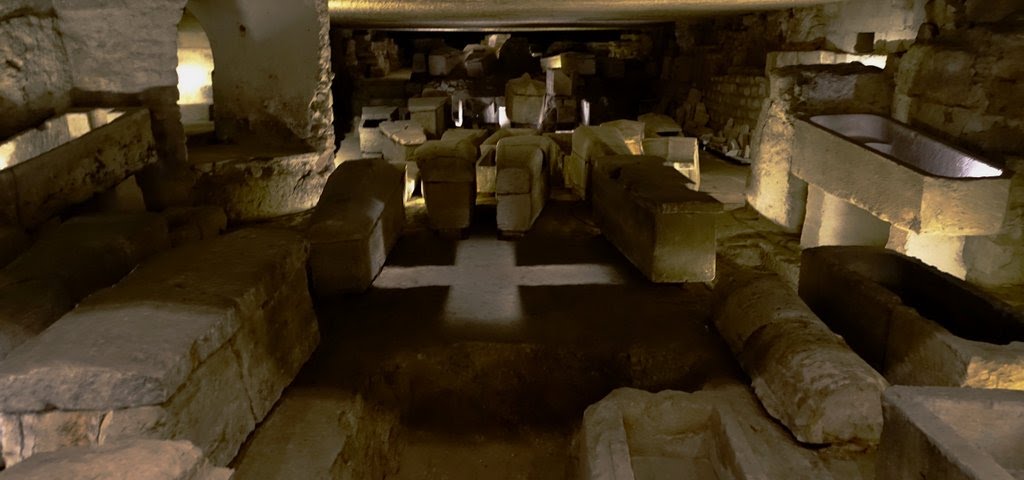
The dark crypt under the cathedral has still more tombs from even further back in time, but the ones, I could see, were empty.
The signature of a flawlessly constructed Gothic cathedral is the magnificent rose window with its stained glass mosaic.

After lunch we ventured out again in the miserable weather to visit Centre Pompidou that is Paris' Musée National d'Art Moderne.
Pompidou was full of other people who wanted to spend the afternoon indoors, – and most museums are closed because it's Monday today.
We were especially interested in seeing the collection from Marc Chagall's 1918-1923 post-revolution period in Russia, but we went through a lot of other artists from the early 1900s.
Marc Chagall, 1920. Le vieil homme aux lunettes.
Marc Chagall, 1919. Anywhere Out of the World.
Vassily Kandinsky, 1916. The Red Square, Moscow.
Pablo Picasso, 1907. Buste de femme.
Sonja Delaunay, 1913. La bal bullier
Yves Klein: Blue square.
However, I think that this old-timer and art afficionada took the prize.

The view from Pompidou's top is half bad, even on a spring day with winter weather.